When we talk about steroids, we may immediately think about bodybuilders who consume it to develop their muscles. However, that is a very narrow view of steroids.
The structure of a steroid molecule is the same as a cholesterol molecule. Your body naturally uses cholesterol from your diet to produce steroids which include :
- Androgens : Controls male physical characteristics and promotes muscle growth.
- Example : Testosterone
- Estrogens and Progestins : Regulates female reproductive cycle and maintains tissue health.
- Example : Extradiol, Progesterone
- Glucocorticoids : Regulates metabolism, blood sugar and stress / inflammation responses.
- Example : Cortisol
- Mineralocorticoids : Regulates salt and water balance to control blood pressure.
- Example : Aldosterone
In medicine, there are two main class of steroids :
- Corticosteroids : responsible for anti-inflammation
- Corticosteroids are produced naturally in the human body.
- They are synthesized into medications such as prednisone, hydrocortisone and dexamethasone.
- They mimic the human body’s stress hormone, cortisol, to turn down the immune system and drastically reduce inflammatory responses.
- It can be used to treat asthma, eczema, psoriasis, atopic dermatitis and rheumatoid arthritis.
- Corticosteroids help regulate the anti-inflammation response of your body’s immune cells. However, corticosteroids are also absorbed by the skin’s fibroblast cells which are responsible for growing new skin cells. Prolonged corticosteroid use impairs skin growth and causes skin thinning.
- Anabolic-Androgenic Steroids : responsible for promoting growth
- Anabolic means “tissue building” especially protein synthesis in skeletal muscle.
- Androgenic means “promotes development of male sexual and secondary characteristics” which can be muscle growth, lean body build, growing facial hair, deepening voice and development of the Adam’s apple.
- These are the ones that most people are familiar with used in bodybuilding and performance enhancement
- They are actually used to treat people with testosterone deficiency, late puberty or muscle loss due to severe illness such as cancer.
How to identify steroids in skincare
Pick up a bottle of skincare product and read through the ingredients list. If you see any of the following combinations, they are highly likely to be steroids.
| Word Segment | Examples of Steroid Ingredients |
|---|---|
| -sone | Hydrocortisone, Betamethasone, Mometassone, Cortisone |
| -olone | Triamcinolone, Prednisolone, Fluocinolone |
| -onide | Desonide, Fluocinonide, Halcinonide |
| -cort- | Cortisone, Hydrocortisone, Fludrocortisone |
| pred- | Prednisone, Prednisolone, Prednicarbate |
| clob- | Clobetasol, Clobetasone |
So how do steroids help relieve skin irritation?
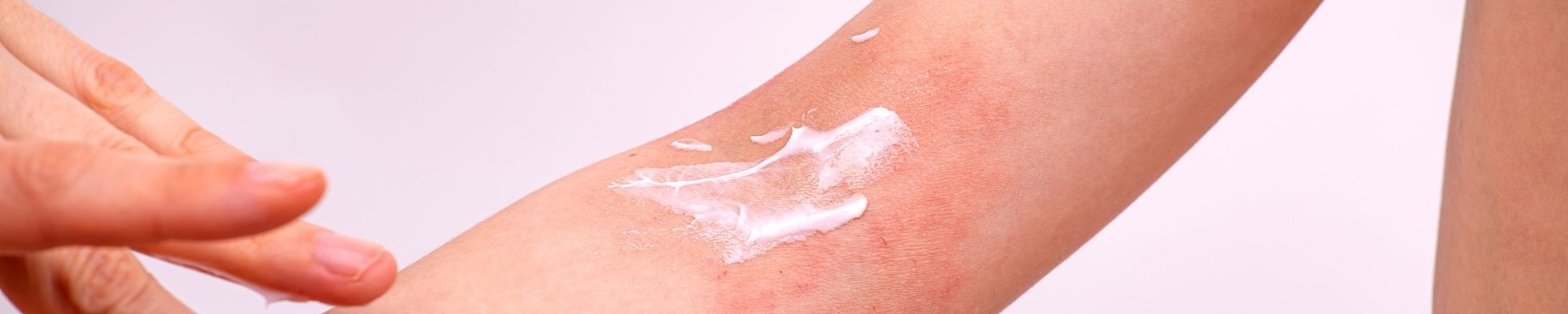
There are skincare, lotions, balms and creams that have added steroids in them to control itchiness, inflammation, redness, irritation and peeling. The class of steroids in these topical skincare are the corticosteroids.
Skin doctors or pharmacists normally recommend a steroid cream to apply for a few days to up to two weeks. Their intention is to stop your body from constantly attacking your skin and causing the irritation and itch that you feel. By removing the irritation and inflammation, scratching and skin damage is reduced. The doctor is trying to give your body a chance to heal.
So what’s BAD about using steroids on our skin then?
If there is prolonged steroid cream usage, your underlying skin cells called fibroblasts will be “turned off”. Fibroblasts are important for producing collagen, elastin and glycosaminoglycans (hyaluronic acid) which work together to keep your skin bouncy, elastic and plump with moisture.
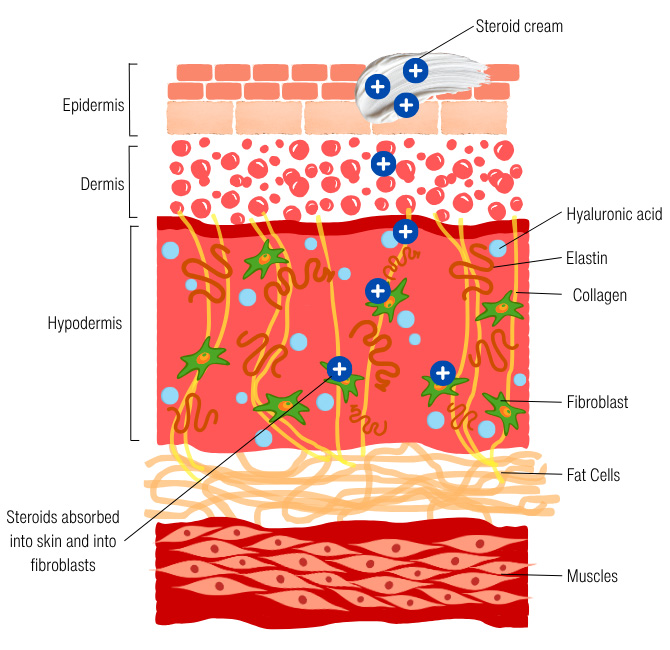
Once the fibroblasts are turned off, your skin will face these problems :
- Collagen production drops by 50%-80%. Skin loses this important protein that is responsible for giving its bounciness, strength and firmness.
- Hyaluronic acid production is inhibited. Skin loses its ability to hold water and subsequently becomes dry and loses its bounciness.
- The fibroblasts themselves no longer divide. There will be less and less fibroblasts working to maintain your skin.
- Enzymes responsible for collagen breakdown that are still present in skin may increase and continue to break down existing collagen. This situation makes your skin lose even more collagen.
Your skin will begin to look abnormally red, smooth and tight. It will be thin, easily torn or bruised. There will be broken blood capillaries and pustules filled with liquid or pus will begin to form.
Are steroid usage side-effects reversible?
When you decide to stop using the steroid creams after a long period of usage, you will experience Topical Steroid Withdrawal (TSW). After stopping steroid usage, your body’s inflammatory systems, immune system and skin processes kick-start again. You will feel skin burns, weeping skin (liquid leaking from skin) and redness as the skin tries to grow again.
It will take a long period of time for the skin to recover to its original eczema state.
It is recommended not to stop steroid application 100% immediately. Slowly reduce the dosage, for example, if you have used it daily, reduce it to only once every 2 days for a week, then once every 3 days for a week and so on.
During the days which you do not apply steroids you may instead substitute your routine with non-steroidal synthesized alternatives.
- Topical Calcineurin Inhibitors (TCIs)
- Examples : Tacrolimus (Protopic), Pimecrolimus (Elidel)
- Mechanism : Inhibits the protein calcineurin which activates T-cells (white blood cells that drive allergic skin inflammation).
- Benefits : Suppress skin inflammation without impairing fibroblast activity thus preventing skin thinning or loss of collagen.
- Topical PDE4 Inhibitors
- Examples : Crisaborole (Eucrisa)
- Mechanism : Blocks phosphodiesterase 4 (PDE4) enzyme inside skin cells thus reducing the production of inflammatory cytokines.
- Benefits : Calms mild-to-moderate flares with low risk of absorption throughout the body.
- Topical JAK Inhibitors
- Examples : Ruxolitinib (Opzelura)
- Mechanism : Blocks Janus Kinase (JAK) signaling pathway which cuts off signal transmission for itch and cytokine release.
- Benefits : Fast itch and redness relief to prevent scratching.
After your condition stabilizes, you can begin to try natural skincare products. Apply the natural skincare alternatives on patches of your skin first for example your arm or on one cheek first to gauge the suitability of the new product before applying it onto wider parts of your body.
Natural alternatives to steroids
Look for skincare products such as lotions, creams or serums with :
- Centella Asiatica (Gotu Kola / Indian pennywort / tiger grass / Cica / Pegaga) : This is a small plant that has the active ingredient madecassoside which is good for skin barrier repair, soothing redness and has anti-aging properties.
- Allantoin : A natural compound extracted from plants such as the comfrey plant. It is gentle on skin, soothes irritation, exfoliates gently and helps moisturize skin. Allantoin can also be synthesized in laboratories.
- Bisabolol : A natural alcohol extracted from German chamomile and the candeia tree. It is gentle on sensitive skin, relieves skin irritation, helps fight acne because of its anti-bacterial nature and helps in the absorption of other nutrients such as Vitamin C. Bisabolol can also be synthesized in laboratories.
- Niacinamide (Vitamin B3) : Stabilize skin barrier and reduces mild redness.